Cold
Hardy Palm Trees Species for Colder Climates -
surprising number of cold hardy Palm Tree species can survive
in cold winter climates which is not expected with a tropical
plant or tree. The most cold hardy Palm Trees types are usually
found naturally growing in high elevations, or in colder climates,
and a cold hardy Palm Tree can withstand a deep winter freeze.
Save time and money buying Palms online from Real Palm Trees' nursery. Palms are grown organically and regularly manicured. Experience "Real" quality at discount prices!
Here you will find Palms with
majestic beauty which can withstand colder winter
climates in a Northern environment. These Palm types
are well suited for parts of America.
The Palm Tree Care and Resources
section helps you choose the right types of Palms
for your environment and hardiness zones.
This
section also contains information and ideas for
protecting the Palm Tree in the cold winter months.
Information and Pictures of
the different types of Palm Trees capable of withstanding
colder climates. The species are:
True
Date Palm Canary
Island Date Palm Texas
Sabal Palm Mediterranean
(European) Fan Palm California
Fan Palm Windmill
Palm Pindo
Palm Sago
Palm Mexican
Fan Palm Queen
Palm
Cold Hardy Palm Trees Species / Types for
Colder Climates
Most cold hardy Palm Tree species
represent the tropics and it can be hard to believe that some cold
hardy palm trees can withstand a deep winter freeze in subzero
temperatures such as Needle Palm species. The Needle Palm tree
type is cold hardy down to a temperature of -10's degrees F.
A variety of cold hardy Palm species
can be grown successfully in Texas (Dallas, Houston, Austin, San
Antonio), California, Florida and much further north. The Palm
Tree species which can withstand colder temperatures are considered
more cold hardy thus we have cold hardy Palm Trees. Windmill palms
and Mediterranean fan palms are known to receive snowfall in their native habitats to give
you an idea on the Palm Trees cold hardiness.
Cold Hardy Palm Tree - The Winter Hardy Palm Species
Variety
Cold Hardy
Palm Tree species vary in their ability to withstand different
minimum temperatures based on the microclimate of the cold hardy
Palm Tree. Here is the microclimate defined courtesy of the National
Arbor Day Foundation.
"Some zip codes are in small areas that
are warmer or cooler than the surrounding area. These areas, called microclimates,
are often associated with urbanization or steep elevation changes,
and many are too small to show on our map.
If it looks on the map like your zip code should
be in a different hardiness zone than the one we provide for you,
your zip code is probably in a microclimate that is too small
to represent on the map.
A good example of this is Chicago, Illinois.
Several zip codes for the city of Chicago bring up zones 5-6.
Microclimates occur in most large cities due to the urbanization
effect that buildings bring about.
In addition, regions of the country with bodies
of water or mountains may contain "pockets." These climatic pockets
mirror warmer or cooler zones than the surrounding region."
The microclimate can be broken
down further to a planting location in your yard. For your cold
hardy Palm Trees you can grow them in locations that provides shelter
from the cold Northern winds, etc... There is more to the successful
growth of a cold hardy palm tree than just the minimum average low
temperature of a location (in parenthesis is the estimated minimum
temperature that the palm tree species can withstand):
California Fan Palms (Washingtonia
filifera)-
(California Fan Palms are cold hardy to 15 degrees)
Windmill Palm Trees (Trachycarpus fortunei) -
(Windmill Palms are cold hardy to 5 degrees)
Pindo Palm Trees(Butia capitata)-
(Pindo Palms are cold hardy to 12 - 15 degrees)
Sago Palm(Cycas revoluta)- (Sago
Palms are cold hardy to 20 degrees)
Mexican Fan Palms(Washingtonia
robusta) -
(Mexican Fan Palms are cold hardy to 18 degrees)
Queen Palm Trees(Syagrus romanzoffiana) - (Queen Palms are cold hardy to 20 degrees)
The cold weather
temperatures listed above are estimates, and preventative measures
for cold protection can be taken enabling, with appropriate care,
the cold hardy palm tree to grow in colder or borderline areas.
I have seen
pictures of a cold hardy Windmill
Palm surviving subzero temperatures (zone 6) with the proper
winter protection. I personally know of a cold hardy Mexican Fan
Palm surviving the cold temperatures in Michigan aided by the creativity
of the owner. He has a 10 foot Palm tree which he wraps during
the frigid storms and places Christmas Tree lights around the
Palm to keep it warm. This particular species should not grow
in Michigan but fellow Palm Tree enthusiasts continue to push
the Northern borders of where the cold hardy Palm Trees species
can grow.
Selecting the Right Palm for your Climate
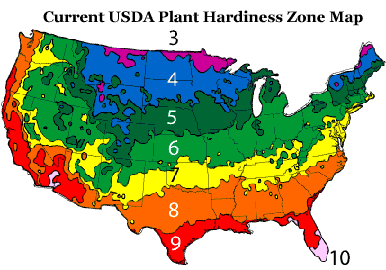
To determine what different types
of Palm Trees species will survive in your environment go to Palm
Trees Cold Hardy Zones Maps Descriptions and Cold
Hardy Zones Maps. - note: This information is based on a 1990
USDA report. There is a new Plant Hardiness report out from the National
Arbor Day Foundation. This report is dated 2006. We will address
it below. The following is a tool to find out what cold hardy zone
you are in based on your zip code. A hardiness zone is a geographically-defined zone in which a specific category of plant life or Palm tree is capable of growing, as defined by temperature hardiness, or ability to withstand the minimum temperatures of the zone.
Interesting video showing the increase of US temperatures over the past 16 years which is moving the warmer Southern weather up North. Palm tree enthusiasts now have a better opportunity to grow more palm species in the Northern US. Florida, California and Texas are no longer the Palm Tree envy of the States.
Cold Hardy Palm Trees of the Same Species may have
Different Reactions to Winter Weather
Not all cold weather (cold hardy)
palm trees are equal. Growers and nurseries occasionally have different
experiences with the same species of palm tree after a cold winter
spell. The reasons for the varying effects on the hardy palms involves
the type of the cold spell and the environment the cold hardy palm
tree is planted in. Hopefully the palm care includes planting the
palm in a location with some degree of protection. Surprisingly
a gradually cooling winter which would seem to give palms an opportunity
to acclimate. But not so according to Goldstein (1989), who found
that a sudden cold frost or freeze was far less devastating than
an extended cold spell where temperatures never dropped to freezing.
The length of time and depth of a hard freeze, wind speed, and
ambient humidity can also influence how destructive a cold spell
might be to a cold hardy Palm tree. That is why some cold hardy
palms can sustain temperatures with little or no damage at one
time, but die at the very same temperature at another (Smith 1958,
1964).
Cold Hardy Palm Tree Care
Microclimates and conditions affecting
palm trees can determine if a garden or landscape hardy palm will
survive. Palm trees sheltered by other trees and shrubs are more
likely to fair better than Palm trees that are exposed to the full
brunt of the winter cold. How successfully a cold hardy palm will
handle cold is determined by the palm itself: its age, its height,
its slight hereditary differences selected out over time by the
conditions of its natural environment, and the overall health of
the cold hardy palm trees at the time of the cold spell.
Cold weather slows the growth
of palm trees, reduces activity of the roots, and can weaken the
plant to the point where a disease can become active and kill
the palm tree. Sometimes, the only above-ground portion of a cold-damaged
palm tree that is still alive is the protected bud. In most cases,
the death of the bud soon after a freeze is due to bacteria that
is present at low levels of a healthy palm tree, but becomes a
problem only after the freeze damage.
Cold Hardy Palm Trees Species Winter protection
Cold hardy palm trees can be assisted
during very cold winter weather. First, plant your cold hardy palm
trees in a warm, sunny spot protected
from winter winds, especially winds from the north
and west. During cold snaps you can protect your cold
hardy palm trees through wrapping the trunk. A cardboard box or
a blanket placed on top of a small palm, and weighted down with
rocks, can provide adequate shelter for most cold hardy palm trees
species. The protective cover should be removed after four or five
days. Another method to protect your cold hardy palm tree is to
temporarily bury it under a mound of mulch. Most of the mulch should
be removed once the weather warms up.
Cold Hardy Palm Trees Problems that can be Caused by Cold Winter
Weather Snaps
Cold Hardy Palm Trees growth rates decrease
during severe cold winters
Cold Hardy rootball development slows down
extreme cold temperatures could weaken Palm
Trees immune system and they become a more likely candidate for
diseases and bugs to disease and insect
Cold Hardy Palm Trees - Resources for Growing Cold
Tolerant Palm Trees species in Colder Climates
Cold Hardy Palm trees additional
information:
The
Hardiest Palms - excellent site from TJ Walters with information
on planting, growing and caring for cold hardy palm trees.
Cool
Tropics - Site is packed full of information on pre-planting
preparations, planting, growing and protecting your hardy Palm
Trees.





 True
Date Palm
True
Date Palm