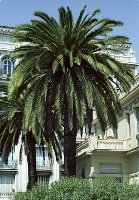
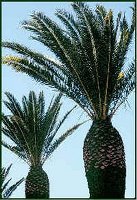
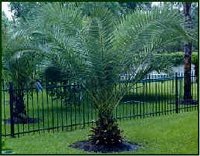
The Canary Island Date Palm Tree (Phoenix canariensis) are native to
the Canary Islands which are located in the Atlantic Ocean
off the coast of northeast Africa. The Cold hardy Canary Island
Date Palm Trees are popular landscape items in near warm climates
around the world.
Canary Island Palm
Trees (Phoenix canariensis) Overview
The Canary Island Date Palm can grow up to 60' and have:
-
A thick trunk covered with interesting diamond designs
-
Crowns that can grow up to 50 huge arching pinnate
leaves that may reach 18' long
-
Leaves that are a deep green
shading to a yellow stem where
the leaflets are replaced by
spines
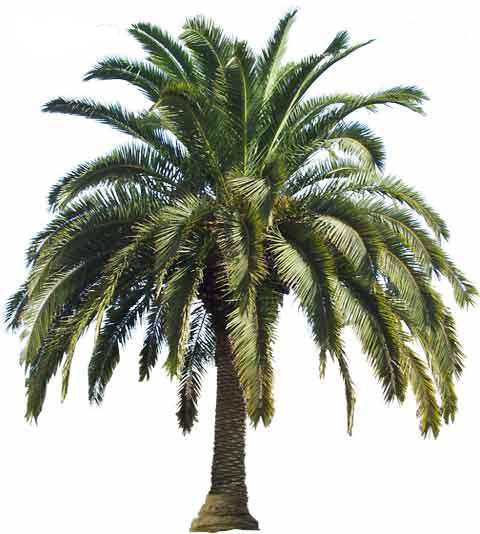
The Canary Island Date Palm tree is a suckering palm that is
usually pruned to have only one trunk. Trimmed in this
manner the tree will grow to heights of 100 feet. Leaflets
near the base are modified into 3-4 inch spines. The
yellow-orange to red fruit, called 'dates', are oblong and
about 1.5 inches in length. They consist of a large pointed
seed surrounded by sweet sugary flesh. Dates are formed from
flowers on 4 foot inflorescences that emerge from among the
leaves in spring. Male and female flowers grow on separate
plants. Only female plants produce dates and only if a male
tree is nearby. Dates are not formed in climates that are
too cool.
Canary Island Date Palm General Information
Scientific name: Phoenix canariensis
Pronunciation: FEE-nicks kan-air-ee-EN-sis
Common name(s): Canary Island Date Palm
Family: Arecaceae
USDA hardiness zones: 9 through 11
Origin: not native to North America
Canary Island Date Palm Description
Height: 40 to 60 feet
Spread: 20 to 25 feet
Crown uniformity: symmetrical canopy with a
regular (or smooth) outline, and individuals have more
or less identical crown forms
Crown shape: palm; upright
Crown density: open
Growth rate: slow
Texture: coarse
Foliage
Leaf arrangement: spiral
Leaf type: odd pinnately compound
Leaflet margin: entire
Leaflet shape: linear
Leaflet venation: parallel
Leaf type and persistence: evergreen
Leaflet blade length: 12 to 18 inches
Leaf color: green
Fall color: no fall color change
Fall characteristic: not showy
Flower
Flower color: white
Flower characteristics: inconspicuous and not
showy; spring flowering; winter flowering
Fruit
Fruit shape: oval; round
Fruit length: .5 to 1 inch
Fruit covering: fleshy
Fruit color: orange; yellow
Fruit characteristics: attracts birds; suited for human
consumption; no significant litter problem; showy
Trunk and Branches
Trunk/bark/branches: grow mostly upright and will
not droop; showy trunk; should be grown with a single
leader; no thorns
Pruning requirement: needs little pruning to develop
a strong structure
Breakage: resistant
Crown shaft: no
Canary Island Date Palm (Phoenix canariensis) Usage
Canary Island Date palm trees have been utilized as a theme
generating focal point in landscapes worldwide for decades.
Its majesty and substantial presence make the Canary Island
Date Palm a powerful choice where you a looking to bring
natural maturity to a site. Utilized in rows or as a
freestanding centerpiece, there really aren't many locations
on site where you cannot use Canary Island Date palm tree
successfully. Probably the best adjective that one could use
to describe Canariensis is Stunning.
|