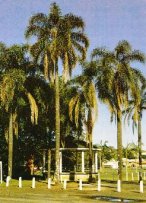
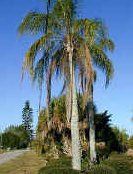
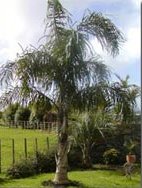
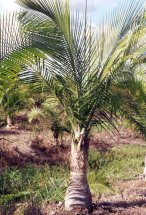
Queen Palm Trees - (Syagrus romanzoffiana)
Native to Brazil, Paraguay and northern
Argentina in South America. This palm is now
widely planted as a landscape item. The Queen
Palm has:
- Growing to maximum height of about 50
feet.
- smooth straight grey trunk ringed with
evenly spaced leaf scars and topped with a
large canopy of feathery plumes
- lacy fronds are a dark glossy green and
have double rows of leaflets.
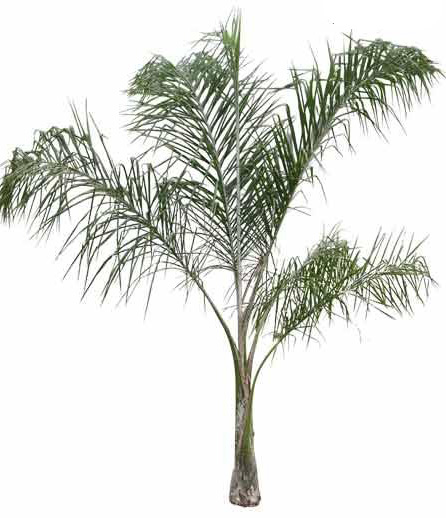
Queen Palm Trees Overview
This palm has a smooth straight gray trunk
ringed with evenly spaced leaf scars and topped
with a large canopy of feathery fronds. The
fronds are dark green and have double rows of
leaflets. This palm is noted for its spectacular
clusters of flowers and fruits. The flower
clusters burst from large pods during the
summer. In early winter, the green fruit
clusters appear. The spherical-shaped fruit
eventually turns bright orange, hanging in
clusters up to six feet in length. In each fruit
there is a single hard seed with three spots.
This stately, single-trunked palm is crowned by a beautiful head of glossy, bright green, soft, pinnate leaves forming a graceful, drooping canopy. The ornamental, bright orange dates are produced in hanging clusters and ripen during the winter months. The dead fronds are persistent and often require pruning to remove. It is popular in commercial or home landscapes planted in rows on 15-foot centers to line a street or walk, in clusters or occasionally as a specimen. The grey trunk is ringed with old leaf scars.
Queen Palm Tree Information
Scientific name: Syagrus romanzoffiana
Pronunciation: sigh-AY-gruss roe-man-zoff-ee-AY-nuh
Common name(s): Queen Palm
Family: Arecaceae
USDA hardiness zones: 9B through 11 (Fig. 2)
Origin: not native to North America
Description
Height: 25 to 50 feet
Spread: 15 to 25 feet
Crown uniformity: irregular
Crown shape: palm, upright/erect
Crown density: open
Growth rate: fast
Texture: fine
Queen Palm Foliage
Leaf arrangement: alternate (Fig. 3)
Leaf type: odd-pinnately compound
Leaf margin: entire
Leaf shape: lanceolate
Leaf venation: parallel
Leaf type and persistence: evergreen
Leaf blade length: 12 to 18 inches, 18 to 36 inches
Leaf color: green
Fall color: no color change
Fall characteristic: not showy
Queen Palm Trees Flowers
Flower color: white/cream/gray
Flower characteristics: showy
Queen Palm Tree Fruit
Fruit shape: round
Fruit length: .5 to 1 inch
Fruit covering: fleshy
Fruit color: orange
Fruit characteristics: does not attract wildlife; showy; fruit/leaves a litter problem
Trunk and Branches
Trunk/bark/branches: branches don't droop; not showy; typically one trunk; thorns
Pruning requirement: little required
Breakage: resistant
Current year twig color: not applicable
Current year twig thickness:
Wood specific gravity: unknown
Queen Palm Tree Culture
Light requirement: full sun
Soil tolerances: clay; sand; loam; acidic; well-drained; occasionally wet
Drought tolerance: moderate
Aerosol salt tolerance: moderate
Other
Roots: not a problem
Winter interest: no
Outstanding tree: no
Ozone sensitivity: unknown
Verticillium wilt susceptibility: resistant
Pest resistance: resistant to pests/diseases
Queen Palm Trees Usage and Maintenance
Growing best in full sun, Queen Palm is most suited for acidic, well-drained soils and shows severe mineral deficiencies on alkaline soil. This disfigures the palm by stunting the young leaves and can kill it. Unfortunately, Queen Palm is frequently planted in alkaline soil and requires regular preventive applications of manganese and/or iron to help keep the fronds green. Potassium deficiency is also displayed on older fronds in well-drained soils. Quick-growing Queen Palm responds well to ample moisture and fertilizer and is slightly salt-tolerant. After planting Queen Palm in the landscape, growth is rapid. This palm is not affected by lethal yellowing disease.
Pruning off too many fronds at one time can cause the palm to decline. Growth often slows with new foliage aborting to display distorted leaflets. The trunk is also very susceptible to decay. Prevent injury to the trunk by keeping turf well away from the trunk.
Propagation is by seed and volunteers will often appear under fruiting trees.
Queen Palm Pests
Palm leaf skeletonizer and scale are problems for Queen Palm
Queen Palm Tree diseases
Ganoderma butt rot can kill Queen Palm. It probably enters the trunk most often through wounds in the lower trunk and roots. There is no control for butt rot, only prevention. |