|

Palm Trees
Palms are common in Florida, California, Arizona, Texas
and many other states. The different localities use Palms and tropical plants to
make beautiful custom landscapes. Palm enthusiasts in locations further North can
still enjoy the tropical beauty of landscape Palms with winter cold hardy Palm
Trees. The care and winter protection you provide for your Palms play a major role
in how far North certain Palm species will survive.
For information on Palms growing further North, the Cold Hardy Palm Tree section
will provide useful information on Palms that can tolerate below freezing winter
cold and if you take appropriate winter precautions Palms can grow as far North as
Michigan. Palm enthusiasts keep pushing the envelope growing Palms in colder
climates. The Palm Tree pictures section shows excellent
images of cold hardy Palm Species. Online Immigration
Specialist Certificate
 Buy Small Palm Trees Buy Medium Palm Trees Buy Large Palm Trees Buy Small Palm Trees Buy Medium Palm Trees Buy Large Palm Trees

In the Palm Tree Types /
Species Comparison, you can find information on a specific Palm Species
expected height at maturity, hardiness zone common for the palm, growth rate, soil
and light requirements, leaf style - those that have palmate or fan-shaped leaves;
and those that have pinnate, or feather-shaped leaves -, and physical
characteristics.
Palms can be temperamental and education is critical so
there is a large section on Palm Tree Care Advice with a strong emphasis
about the species but the majority of the site is aimed at cold hardy Palm Trees and
the information and pictures are easily digestible.
Sun Palm Trees' web site is meant to assist Palm
Tree enthusiasts throughout the United States including Florida, North Texas
(Dallas), Houston, California, Arizona, Louisiana, Mississippi, Alabama, Georgia and
states much further North where cold hardy Palm Trees can be grown with the proper
planting and care especially through the cold winter months.
Palm tree installation begins with the choosing of the
palms that would work best for your landscape and your budget. There are thousands
of different kinds of palms from large to small, but the most popular ones are the
ones we focus on. If interested to cook some amazing pizzas with palm tree oil you
should think about buying an oven for home pizza
The following Palm Tree are majestic looking and handle
the cold better than other Palm species. You can click on the name to go directly to
its information page. The Cold Hardy Palm Trees
for Colder Climates provides advice on how to care for your Palm in marginal
growing environments and identifies Palms considered to be cold hardy. The following
Palm are described in detail:
In the Palm Care and
Advice section we address Palm Trees Frequently Asked
Questions and you can read information about Selecting a Palm Tree, the Cold
Hardy Zone System, growing Cold Hardy Palms in marginal climate zones and planting
Palms. We also have extensive coverage on the USDA Plant Hardiness Zones. We
identify what the cold hardiness zone maps are, Palm Trees Cold Hardy
Zones Maps Descriptions, and the different zones across North America, Cold Hardy Zones Maps. Palm Trees
successful growth in colder winter areas depend on the cold hardiness of the
particular types of Palms, the growing micro-environment and of course your care.
Palm photos are located throughout the site. The Palm
photo galleries can be viewed at the
Cold Hardy Palm Trees Pictures
section. Below are links to Palm Tree image galleries.
Below are 12 common types of Palms that grow in North
America. There are many factors that determine the successful planting and
maintaining of a species. Microclimates and and other environmental factors
determine if a garden or landscape hardy palm will survive in hardiness zones lower
than the USDA recommends. Palm tree protected by other trees and shrubs will
tolerate the cold winter environment easier than if exposed to the full force of the
winter cold. How it handles the winter is partially predetermined by the palm
itself: its age, its height, its slight hereditary differences selected out over
time by the conditions of its environment, and the health at the time of a winter
cold snap.
Sun Palm Trees suggests to always
verify a particular Palm species can be successfully grown in your region and
particular micro-climate prior to Purchase. Ensure you have the proper winter
protection for the cold winter months and talk to your palm grower or specialist.
Doing a Google search for individuals successfully growing Palms in your area may
give you some good pointers.
|
|
|
|
|
|
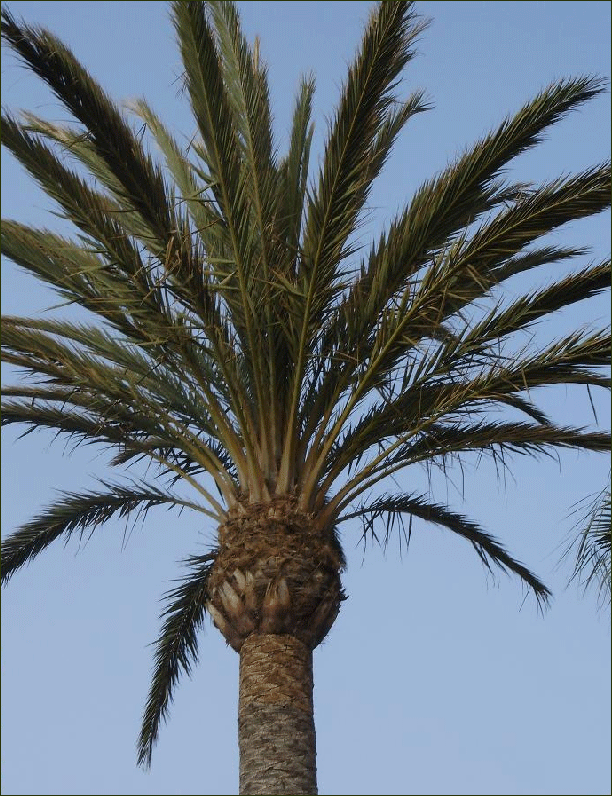
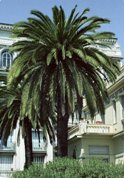
True Date Palms
(Phoenix dactylifera)
The
"edible" or Date Palm Tree makes for spectacular landscaping large
areas. The True Date reaches heights of 100'.
 Buying Information Buying Information
|
Canary Island
Date Palms
(Phoenix canariensis)
Canary Island
Dates are massive, tough and durable. It has a leaf scar pattern on the
trunk which adds to the impressive look.
Buying Information
|
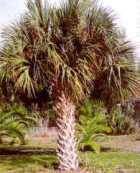
Texas Sabal Palms
(Sabal texana, mexicana)
Use the Texas Sabal in formal groupings, as a
lawn tree, in large-scale plantings and as that special accent
tree.
Buying Information for Sabals
|
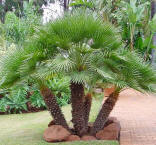
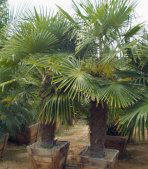
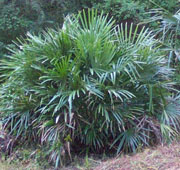
Mediterranean Fan
Palms
(Chamaerops humilis)
Also called the European Fan Palm this
versatile, cold hardy and beautiful. With the fan leaves trimmed up to
clear the trunk it makes a beautiful specimen Palm - a delightful natural
sculpture to grace your patio or entryway.
Buying Information
|
 |
|
|
|
|
|
|
California Fan
Palms
(Washingtonia filifera)
The largest
native palm of the continental United States as well as the only western
species, it is also known as "Desert-palm"
Buying Information
|
Windmill Palm Tree
(Trachycarpus fortunei)
Windmill Fan
Palms are one of the hardiest in cultivation. They have a distinct look
with the trunk covered by dark brown fibers.
Buying Information
|
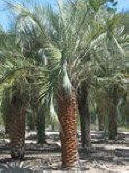
Pindo Palm Tree
(Butia capitata)
The Pindo is
the hardiest Feather leaf palm in wide cultivation. The species are
extremely variable in nature with differences in height, leaf colors and
trunk thickness.
Buying Information
|
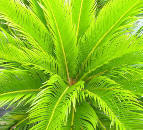
Sago Palms
(Cycas revoluta)
Sago Palm are
actually Cycads or plants. It is not a true Palm but commonly associated as
one.
Buying Information
|
|
|
|
|
|

|
|
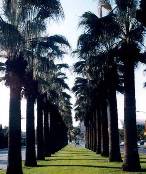
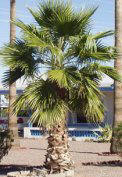
Mexican Fan
Palm
(Washingtonia robusta)
Mexican Fan Palm is
very drought and salt tolerant once established. Adapted to a wide range
of soil types, and climates.
Buying Information
|
Queen Palm
Tree
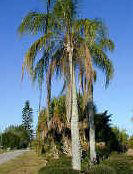
(Syagrus romanzoffiana)
Tall and graceful with
leafy fronds, this palm gives landscapes a tropical look. Very showy,
especially when clumped.
Buying Information
|
Needle Palm
(Rhapidophyllum
hystrix)
Beautiful compact, very
hardy, and can be grown as far north as USDA zone 6. Probably the hardiest
palm species in the world
Buying Information
|
Saw Palmetto Palm
(Serenoa repens)
Very old Saw Palmetto can grow trunks above the ground
several feet tall capped by a rosette of exotic fans of palm leaves.
Buying Information
|
Palm Tree Information
We hope you find the information and pictures of the Palm species useful. Tropical
plant and Palm hobbyists are growing Palms in marginal climates now. You can just
look at all the Palm Tree
Discussion Boards across the country and many focus on the Northern US.
Please contact
us rodclarkson.com regarding any
recommendations/suggestions about the site.
Safe
Flight Aviation
|